business finance and financial management
MEANING OF BUSINESS FINANCE
MONEY REQUIRED FOR CARRYING OUT BUSINESS ACTIVITIES(selling and buying of goods and services)is called business finance.
Problems with growth: lack of finance
As your business grows, you will need more funding. This is to cover paying for:
- new staff
- facilities
- raw materials
- supplies
- developing new products and features
Finance is the life blood of business. The growth and expansion depend upon the availability of fund
Absence of finance or shortage of finance create toxic problem in business activities gradually the business will shut down.
Meaning of business finance
Business finance refers to money and credit employed in business. It involves procurement and utilization of funds so that business firms may be able to carry out their operations effectively and efficiently. ... i) Business finance includes all types of funds used in business.
scope of financial management :
Some of the major scope of financial management are as follows: 1. Investment Decision 2. Financing Decision 3. Dividend Decision 4. Working Capital Decision.
1. Investment Decision:
The investment decision involves the evaluation of risk, measurement of cost of capital and estimation of expected benefits from a project. Capital budgeting and liquidity(working capital) are the two major components of investment decision. Capital budgeting is concerned with the allocation of capital and commitment of funds in permanent assets which would yield earnings in future.
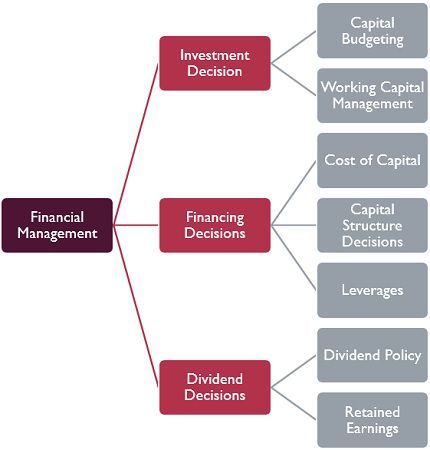
A. Capital budgeting(A long -term investment decision) also involves decisions with respect to replacement and renovation of old assets. The finance manager must maintain an appropriate balance between fixed and current assets in order to maximize profitability and to maintain desired liquidity in the firm.
Capital budgeting is a very important decision as it affects the long-term success and growth of a firm. At the same time it is a very difficult decision because it involves the estimation of costs and benefits which are uncertain and unknown.
B. Working capital Decisions:- (short term investment decisions)are concerned with the cash inflow and out flow ,inventories(raw materiel,work-in-progress and finished stock of goods),sundry debtors. It will discriminate the smooth flow and profitability of business.
2. Financing Decision:This decision is about the quantum of finance to be raised from various Long-term sources ,which may be debt or equity.
While the investment decision involves decision with respect to composition or mix of assets, financing decision is concerned with the financing mix or financial structure of the firm. The raising of funds requires decisions regarding the methods and sources of finance, relative proportion and choice between alternative sources, time of flotation of securities, etc. In order to meet its investment needs, a firm can raise funds from various sources.
Capital structure
The finance manager must develop the best finance mix or optimum capital structure for the enterprise so as to maximize the long- term market price of the company’s shares. A proper balance between debt and equity is required so that the return to equity shareholders is high and their risk is low.
Use of debt or financial leverage effects both the return and risk to the equity shareholders. The market value per share is maximized when risk and return are properly matched. The finance department has also to decide the appropriate time to raise the funds and the method of issuing securities.
3. Dividend Decision:(This decision relates to the appropriation of profits earned) .The decision relate to dividends and retained earnings(ploughing back of profit)
In order to achieve the wealth maximization objective, an appropriate dividend policy must be developed. One aspect of dividend policy is to decide whether to distribute all the profits in the form of dividends or to distribute a part of the profits and retain the balance. While deciding the optimum dividend payout ratio (proportion of net profits to be paid out to shareholders).
The finance manager should consider the investment opportunities available to the firm, plans for expansion and growth, etc. Decisions must also be made with respect to dividend stability, form of dividends, i.e., cash dividends or stock dividends, etc.
Working Capital Decision:
Working capital decision is related to the investment in current assets and current liabilities. Current assets include cash, receivables, inventory, short-term securities, etc. Current liabilities consist of creditors, bills payable, outstanding expenses, bank overdraft, etc. Current assets are those assets which are convertible into a cash within a year. Similarly, current liabilities are those liabilities, which are likely to mature for payment within an accounting year.
CAPITAL BUDGETING DECISION /Management of Fixed Capital
According to Milton “Capital budgeting involves planning of expenditure for assets and return from them which will be realized in future time period”.
For a wealth-maximizing business enterprise, the most common form of investment is
in real corporate assets (i.e. land, buildings, plant & machinery etc.) Such assets are
very important for most firms as they represent the largest financial investment and
are the key earning assets of the firm.
Importance /nature/scope of capital budgeting
1. Long Term Effect: Such decisions have long term effect on future profitability and influence pace of firms growth. A good decision may bring amazing returns and wrong decision may endanger very survival of firm. Hence capital budgeting decisions determine future destiny of firm.
2. High Degree of Risk: Decision is based on estimated return. Changes in taste, fashion, research and technological advancement leads to greater risk in such decisions.
3. Huge Funds: Large funds are required and sparing huge funds is problem and hence decision to be taken after proper care .
4. Irreversible Decision: Reverting back from a decision is very difficult as sale of high value asset would be a problem.
5. Most Difficult Decision: Decision is based on future estimates/uncertainty. Future events are affected by economic, political and technological changes taking place.
6. Impact on Firms Future Competitive Strengths: These decisions determine future profit or cost and hence affect the competitive strengths of firm.
7. Impact on Cost Structure: Due to this vital decision, firm commits itself to fixed costs such as supervision, insurance, rent, interest etc. If investment does not generate anticipated profit, future profitability would be affected.
Factors affecting capital budgeting decisions are :-
1 technological changes: The modern world facing the swift changes in technological know how like machine and fuel and power so the decision must be a logical.
2.Cash flow of the project: The fixed asset decision ensure the regular flow of cash in to the business. The investment return is poor ;the business will struggle to exist. So it must ensure the return on investment what they expect.
3.Investment Criteria Involved :
2.Cash flow of the project: The fixed asset decision ensure the regular flow of cash in to the business. The investment return is poor ;the business will struggle to exist. So it must ensure the return on investment what they expect.
3.Investment Criteria Involved :
While taking a decision about the investment on long term asset ,we consider the following factor like a. Amount of investment b.Interest rate c .cash flow d. Rate of return on investment: The Manager must select the most profitable investment.
4.The amount of. risk:-
The firm ensure the least risk on investment i.e interest rate ,flotation cost(under writing charges, brokerage and commission etc). It will determine the profitability of organisational investment.
The Factors affecting Financing Decision :-
1. The cost of investment:-The rate of interest on the source of fund must be least. The cheapest source must identify among the various source of finance.
eg. Debenture source or Debt is consider the cheapest source because the interest on debt is a tax deductible expense.
2.Risk.:- It will determine the interest or dividend and redemption of debt or source of funds.so the cost must be minimum.
eg. equity share --no compulsion to pay dividend.
2 6%Debenture --2,00,000 - means 12,000 interest yearly payable etc
3.Flotation costs :
In order to raise fund need some cost(Flotation costs are incurred by a publicly traded company when it issues new shares and debentures and includes expenses such as ,under writing charges, legal fees and registration fees. Companies must consider the impact these fees will have on how much capital they can raise from a new issue. Flotation costs, expected trading on equity, dividend payments and the percentage of earnings the business expects to retain are all part of the equation to calculate a company's cost of new equity.The flotation cost must be the minimum.
4.Cash flow position of the business:-Debt financing consider strong flow of finance. because it is cheep than other sources.
5. Level of fixed operating cost:-If a business has high level of fixed operating cost(e.g. Building rent ,insurance, preliminaries expenses,wages etc.).lower debt financing is better Similarly,if fixed operating cost is less,more of debt financing may be preferred.
6.Control considerations:- Issue of more equity may lead to dilution of management control over the business. debt financing has no such implication .If there is too much debt,then share holders are likely to loss control to debenture holders..
7.State of capital markets:-During depression /recession,people do not like to take risk and are not interested in buying equity shares .But during boom,investors are ready to take risk and invest in equity shares.
The financial management is generally concerned with procurement, allocation and control of financial resources of a concern. The objectives can be-
SHAREHOLDER'wealth =NO.OF SHARES HELD X MARKET PRICE OF SHARES
3.Flotation costs :
In order to raise fund need some cost(Flotation costs are incurred by a publicly traded company when it issues new shares and debentures and includes expenses such as ,under writing charges, legal fees and registration fees. Companies must consider the impact these fees will have on how much capital they can raise from a new issue. Flotation costs, expected trading on equity, dividend payments and the percentage of earnings the business expects to retain are all part of the equation to calculate a company's cost of new equity.The flotation cost must be the minimum.
4.Cash flow position of the business:-Debt financing consider strong flow of finance. because it is cheep than other sources.
5. Level of fixed operating cost:-If a business has high level of fixed operating cost(e.g. Building rent ,insurance, preliminaries expenses,wages etc.).lower debt financing is better Similarly,if fixed operating cost is less,more of debt financing may be preferred.
6.Control considerations:- Issue of more equity may lead to dilution of management control over the business. debt financing has no such implication .If there is too much debt,then share holders are likely to loss control to debenture holders..
7.State of capital markets:-During depression /recession,people do not like to take risk and are not interested in buying equity shares .But during boom,investors are ready to take risk and invest in equity shares.
factors affecting dividend decision:-
Dividend decision, one of the important aspects of company’s financial policy, is not an independent decision. Rather, it is a decision that is taken after considering the various related aspects and factors. There are various factors influencing a firm's dividend policy. For example, some studies suggest that dividend policy plays an important role in determining firm capital structure and agency costs. Many studies have provided arguments that link agency costs with the other financial activities of a firm. dividends in order to reduce agency costs. Dividend payout keeps firms in the capital market, where monitoring of managers is available at lower cost.Theoretically, over the past number of years, it has been believed by the academicians that the dividend decision is influenced by number of factors. Some of the factors that affect the dividend decision of a firm are listed as follows:
1. Legal Provisions: Indian Companies Act, 1956 has given the guidelines regarding
legal provisions as to dividends. Such guidelines are required to be followed by
the companies whenever the dividend policy is to be formulated. As per the
guidelines, a company is required to transfer a certain percentage of profits to
reserves in case the dividend to be paid is more than 10 percent. Further, a company is also required to pay dividend only in cash but only with the exception
of bonus shares.
2. Magnitude of Earnings: Another important aspect of dividend policy is the
extent of company’s earnings. It serves as the introductory point for framing the
dividend policy. This is so because a company can pay dividends either from the
current year’s profit or the past year’s profit. So, if the profits of a company
increase, it will directly influence the dividend declaration as the latter may also
increase. Thus, the dividend is directly linked with the availability of the earnings
with the company.
3. Desire of Shareholders: The decision to declare the dividends is taken by Board of Directors but they are also required to consider the desire of the shareholders, which depend on the latter’s economic condition. The shareholders, who are economically weak, prefer regular dividend policy while the rich shareholders may prefer capital gains as compared to dividends. However, it is very difficult for the board to reconcile the conflicting interests of different shareholders yet the dividend policy has to be framed keeping in view the interest of all the interested parties.
3. Desire of Shareholders: The decision to declare the dividends is taken by Board of Directors but they are also required to consider the desire of the shareholders, which depend on the latter’s economic condition. The shareholders, who are economically weak, prefer regular dividend policy while the rich shareholders may prefer capital gains as compared to dividends. However, it is very difficult for the board to reconcile the conflicting interests of different shareholders yet the dividend policy has to be framed keeping in view the interest of all the interested parties.
4. Nature of Industry: The nature of industry in which a company is operating,
influences the dividend decision. Like the industries with stable demand throughout the year are in a position to have stable earnings, thus, should have the
stable dividend policy and vice-versa.
5. Age of the Company: A company’s age also determine the quantum of profits to
be declared as dividends. A new company should restrict itself to lower dividend
payment due to saving funds for the expansion and growth (making them to retain the earnings )as compared to the
already existing companies who can pay more dividends.
6. Taxation Policy: The tax policy of a country also influences the dividend policy
of a company. The rate of tax directly influences the amount of profits available
to the company for declaring dividends.
7. Control Factor: If a company declares high rate of dividend, then there is the
possibility that a company may face liquidity crunch for which it has to issue new
shares, resulting in dilution of control. Keeping this threat in view, a company may go for lower level of dividend payments and more ploughing back of profits
in order to avoid any such threat.
8. Liquidity Position. If a company does not have sufficient cash resources to make dividend
payment, then it may go for issue of bonus shares.
9. Future Requirements: A company while farming dividend policy should also
consider its future plans. If it foresees some profitable investment opportunities in
near future then it may go for lower dividend and vice-versa.
10. Agency Costs: The separation of ownership and control results in agency
problems. Agency costs can be reduced by distributing dividends . In this stratum, dividends are paid out
to stockholders in order to prevent managers from building unnecessary empires
to be used in their own interest. In addition, dividends reduce the size of internally
generated funds available to managers, forcing them to go to the capital market to
obtain external funds firms with a larger percentage of outside equity holdings are subject to higher
agency costs. The more widely spread is the ownership structure, the more acute
the free rider problem and the greater the need for outside monitoring. Hence,
these firms should pay more dividends to control the impact of widespread
ownership.
11. Business Risk: Business risk is a potential factor that may affect dividend policy.
High levels of business risk make the relationship between current and expected
future profitability less certain. Consequently, it is expected that firms with higher
levels of business risk will have lower dividend payments. Many researchers
argued that the uncertainty of a firm’s earnings may lead it to pay lower dividends
because volatile earnings materially increase the risk of default.
12. If a firm has free cash flows, it is better to share them with shareholders in the form of dividend in order to reduce the possibility of these funds being wasted on unprofitable.
ROLE OF FINANCIAL MANAGEMENT :
ROLE OF FINANCIAL MANAGEMENT :
Financial Management means planning, organizing, directing and controlling the financial activities such as procurement and utilization of funds of the enterprise.
The financial managers always search for the maximization of the wealth of share holders.Financial management aim a reducing the cost of fund s procured .It also aims at ensuring availability of sufficient funds .
The future growth and development of organisation also determined on the smooth flow of fund.
The following aspects being affects on financial decisions :-
1. The size as well as the composition of fixed assets of the business
2. The quantum to current assets as well as its break -up into cash ,inventories and r receivables
3. The amount of long -term and shot term financing to be used.
4. Break-up of long term financing into debt,equity etc is also a financial management.
decision
5. All items in the profit and loss account e.g. Interest expenses, depreciation etc. Higher .amount of debt means higher interest expenses.
Objectives of Financial Management
The financial managers always search for the maximization of the wealth of share holders.Financial management aim a reducing the cost of fund s procured .It also aims at ensuring availability of sufficient funds .
The future growth and development of organisation also determined on the smooth flow of fund.
The following aspects being affects on financial decisions :-
1. The size as well as the composition of fixed assets of the business
2. The quantum to current assets as well as its break -up into cash ,inventories and r receivables
3. The amount of long -term and shot term financing to be used.
4. Break-up of long term financing into debt,equity etc is also a financial management.
decision
5. All items in the profit and loss account e.g. Interest expenses, depreciation etc. Higher .amount of debt means higher interest expenses.
Objectives of Financial Management
The financial management is generally concerned with procurement, allocation and control of financial resources of a concern. The objectives can be-
